

GPU depreciation: why the accounting schedule and the resale value disagree

 |
Simon Harrsen - EVP North America
Published October 21, 2026 · 9 min read
|
GPU depreciation has become one of the most debated numbers in technology finance. A GPU, or graphics processing unit, is the chip that runs most artificial intelligence work. Companies now spend hundreds of thousands of dollars on a single GPU server. How fast that server loses value shapes reported profits, budgets, and refresh plans. For enterprises weighing AI infrastructure financing, the question is practical: what will the hardware be worth when you are done with it?
The short answer is that two different clocks are running. The first clock measures how long a GPU server stays useful. The second clock measures how long the server holds its resale value. The useful-life clock runs for five to six years. The resale-value clock runs much faster. This article explains why the two clocks disagree, what CHG-MERIDIAN's own residual estimates show, and what the gap means for an enterprise AI budget.
- GPU depreciation spreads the cost of a GPU server over its expected useful life. The largest cloud providers use five to six years.
- A five to six year useful life is realistic for the work a GPU server can do. Some Nvidia A100 chips, launched in 2020, are under contract through 2029.
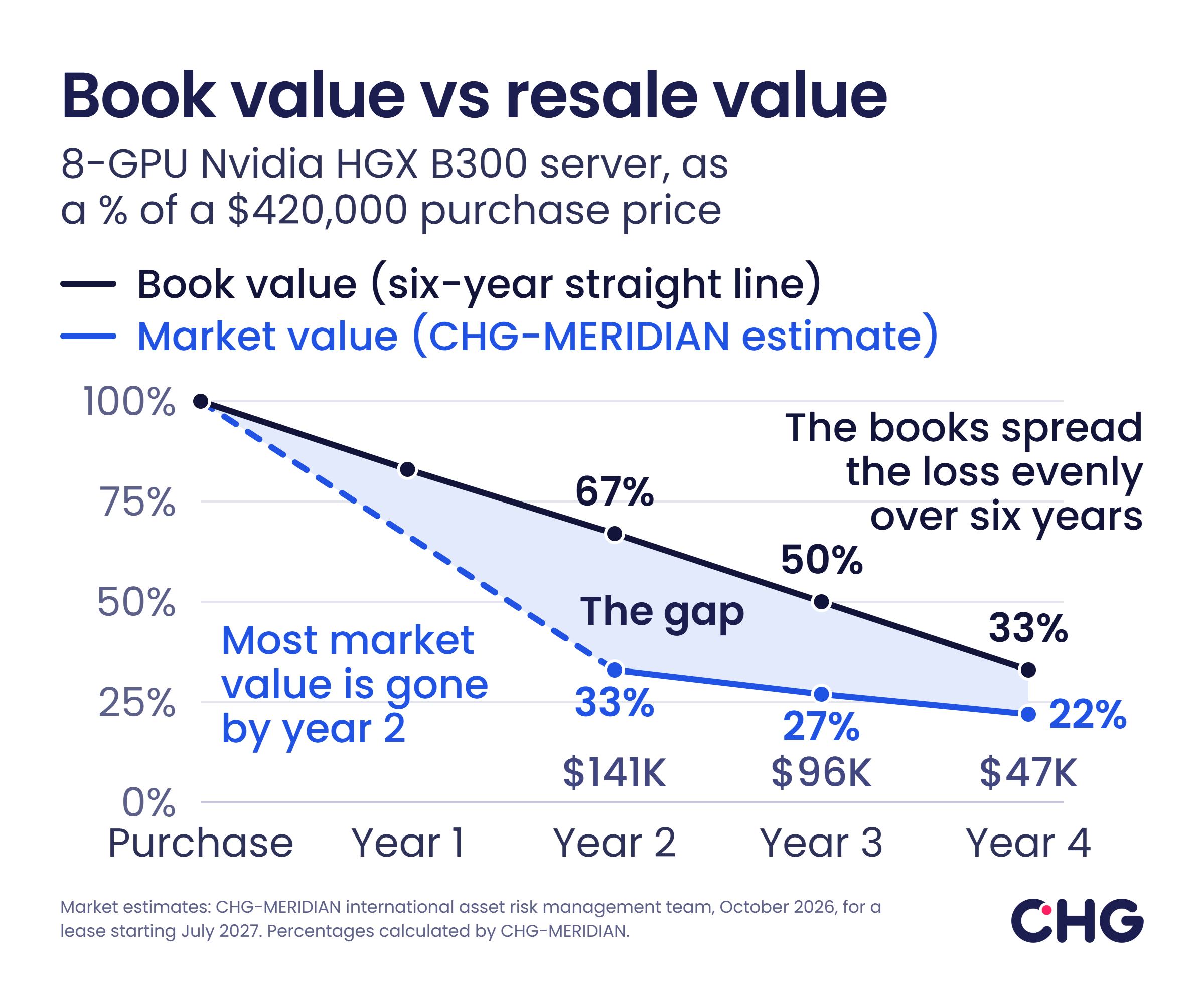
- Resale value falls much faster than a straight-line schedule assumes. CHG-MERIDIAN estimates put an Nvidia B300 server at about 33% of its purchase price after two years.
- On a six-year straight-line schedule, the same server would still be on the books at about 67% of its price after two years.
- An enterprise that buys a $420,000 GPU server and refreshes it after three years could book a loss of roughly $96,000 when it sells.
- A fair market value lease moves that resale risk from the enterprise to the leasing company.
What is GPU depreciation?
Depreciation is how a company spreads the cost of a long-lasting asset over the years it expects to use the asset. The expected period of use is called the useful life. The value still on the company's books at any point is called the book value.
Most companies depreciate servers on a straight-line basis. Straight-line means the same amount is written off every year.
Here is a simple example. A company buys a GPU server for $420,000. The company sets a useful life of six years. Each year, the company records $70,000 of depreciation. After two years, the book value is $280,000. After three years, the book value is $210,000. After six years, the book value is zero.
GPU depreciation is the same idea applied to GPU servers. The debate is not about the method. The debate is about the useful life, and about whether the book value tracks what the server is actually worth.

How long do companies depreciate GPU servers?
Most large technology companies depreciate servers over five to six years. The table shows the policies disclosed in each company's most recent annual report.
| Company | Useful life for servers | Most recent change |
| Alphabet | Generally six years | No change disclosed in the latest annual report |
| Microsoft | Two to six years | No change disclosed in the fiscal 2026 annual report |
| Meta | Five to five and a half years, with most servers at five and a half | Extended most servers to five and a half years, effective January 2025 |
| Amazon | Six years, with a subset at five years | Shortened a subset of servers and networking equipment from six to five years, effective January 2025 |
| CoreWeave | Six years | Adopted six years in 2023 |
Source: company 10-K filings for fiscal 2025, and Microsoft's 10-K for fiscal 2026.
Two of the largest buyers moved in opposite directions on the same date. Meta lengthened the useful life of most of its servers. Amazon shortened the useful life of part of its fleet. Amazon said in its 2024 annual report that the shorter life reflects a faster pace of technology development, particularly in artificial intelligence.
Five to six years is a reasonable estimate of how long a GPU server can keep doing useful work. Older chips still find buyers and renters. In August 2026, CoreWeave signed a contract for Nvidia A100 capacity that runs into 2029. The A100 launched in 2020, so the contract stretches the chip's working life to about nine years.
Why are Michael Burry and CoreWeave arguing about GPU depreciation?
The debate went mainstream in November 2025. Michael Burry, the investor known for “The Big Short,” accused large cloud providers of understating GPU depreciation to boost earnings. Burry argued that Nvidia chips follow a two to three year product cycle. In his view, a five to six year useful life is too long. He estimated that the industry would understate depreciation by about $176 billion from 2026 through 2028.
CoreWeave became the focus of the debate. CoreWeave is a neocloud, a cloud company that specializes in renting GPU computing power. CoreWeave depreciates its GPUs over six years, and most of its assets are GPU servers. If six years is too long, CoreWeave's reported profits are overstated more than most.
The evidence supports parts of both sides.
The case for a long useful life is strong. GPUs keep working, and older GPUs keep earning revenue. The A100 contract running into 2029 is one example.
The case for faster value loss is also strong. Rental prices for Nvidia's H100 chip fell about 70% from their peak, from more than $8 an hour to about $2.50 an hour, according to a December 2025 analysis from Princeton University's Center for Information Technology Policy. The analysis argues that the secondary market does not support five to six year schedules.
The two sides are measuring different things. Burry is talking about economic value. CoreWeave is talking about useful life. A GPU server can stay useful for six years and still lose most of its value in the first two.
What is a GPU server actually worth after two, three, and four years?
Very little public data exists on what GPU servers sell for at the end of their first use. CHG-MERIDIAN leases GPU servers and resells them at the end of each lease, so we asked our international asset risk management team for estimates.
The team estimated end-of-lease values for an Nvidia HGX B300 server, a common eight-GPU system for AI training. The estimates assume the server is bought new for a lease starting in July 2027. The team values equipment per GPU. We multiplied each value by eight to get the value of a full server. We then compared each server value with a public reference price of about $420,000 to get a percentage. The percentages are our calculation, not the team's.
The table sets those estimates against the book value on a six-year straight-line schedule.
| Age of server | Book value on a six-year schedule | CHG-MERIDIAN market estimate | Gap |
| 2 years | About $280,000 (67%) | About $139,000 (33%) | About $141,000 |
| 3 years | About $210,000 (50%) | About $114,000 (27%) | About $96,000 |
| 4 years | About $140,000 (33%) | About $93,000 (22%) | About $47,000 |
Market estimates provided by CHG-MERIDIAN's international asset risk management team, October 2026, for an 8x Nvidia HGX B300 server bought for a lease starting July 2027. Values converted from euros at about $1.15 per euro. Book values and percentages are CHG-MERIDIAN's calculation against a reference price of about $420,000.
These are estimates, not guarantees. GPU servers have a short resale history, and the used market has changed quickly. Actual values will depend on the purchase price, the configuration, and market conditions when the lease ends. We will update these figures as the market develops.
The pattern matters more than any single number. The gap between book value and market value is widest early. At two years, the books overstate the server's value by about half. By four years, the gap has narrowed, because the book value has caught up with the market. Most of the market value is gone in the first two years, while the straight-line schedule spreads the loss evenly over six.
We use the same residual estimates to compare owning and renting in our analysis of the cost crossover between on-premise AI and cloud.
Why do GPUs lose value faster than other servers?
Three forces push GPU values down faster than the values of ordinary servers.
The first force is the release cycle. Nvidia now releases a new data center GPU architecture about once a year. Each new generation does more work for the same money. Buyers pay less for the generation before it.
The second force is power. Data centers have a limited supply of electricity. A newer GPU produces more AI work for each unit of power it uses. When power is the bottleneck, an older GPU costs more to run per unit of work, even if the older GPU still works perfectly.
The third force is the buyer pool. The companies that buy used data center GPUs are often the same companies that rent out GPU capacity. When rental prices fall, those buyers pay less for used hardware.
Wear is not the main driver. Running GPUs around the clock does cause some failures. During a 54-day stretch of training on 16,384 H100 GPUs, Meta recorded 148 faulty GPUs and 72 GPU memory failures, according to Meta's Llama 3 research paper. Those failures touched fewer than 2% of the GPUs in the cluster.
CHG-MERIDIAN's asset risk management team values used hardware mainly by its components: the GPUs, the processors, and the memory. The age of the technology moves the price far more than the hours the hardware has run.
What GPU depreciation means for an enterprise AI budget
The gap between book value and market value only becomes a cost when the hardware leaves the company. An enterprise that sells or retires a server early turns the gap into a loss on its income statement.
Here is how that plays out. An enterprise buys an eight-GPU B300 server for $420,000. The finance team depreciates the server over six years. After three years, the AI team wants the next GPU generation. The server is still on the books at $210,000. The market will pay about $114,000. The enterprise records a loss of about $96,000 when it sells. The loss arrives in the same year the enterprise is paying for new hardware.
Shorter refresh cycles make this more likely. CHG-MERIDIAN sees enterprise customers choosing shorter lease terms for AI hardware than for traditional servers. The reason is simple. Each new GPU generation changes what an AI team can do, and few teams want to wait six years for an upgrade.
Holding the server for the full six years avoids the loss on paper. But the enterprise then runs hardware that is several generations behind, and pays more in power for each unit of AI work.
How does leasing change GPU depreciation risk?
A fair market value lease changes who carries the risk of falling value. In a fair market value lease, the monthly payments are based mainly on the value the leasing company expects the server to lose during the term. The leasing company owns the server and keeps the remaining value at the end.
Here is the same B300 example under a three-year fair market value lease. The enterprise pays for the use of the server over three years. At the end of the term, the enterprise returns the server. If the server is worth less than the leasing company expected, the leasing company takes the loss. The enterprise has no gap between book value and market value to write off.
Most CHG-MERIDIAN customers with GPU leases return the hardware at the end of the term and move to the next generation. Some customers extend the lease for a period, because the hardware still does the job they need. A lease keeps both options open.
Through its server and data center equipment leasing program, CHG-MERIDIAN carries the residual value risk on GPU hardware so the enterprise does not have to.
Leasing is different from renting compute. With GPU as a service, an enterprise rents capacity in a provider's data center and has no hardware at all. With a lease, the enterprise runs the hardware in its own data center or colocation space, under its own control.
How to set a realistic GPU depreciation plan
Finance and IT teams can use five steps to keep GPU depreciation from surprising the budget.
- Decide the refresh date first. Ask the AI team how long the hardware needs to stay current. The refresh date matters more than the useful life.
- Compare book value with market value at the refresh date. Use the depreciation schedule for the book value. Use a residual estimate from a lessor or remarketer for the market value.
- Budget for the gap, or move the risk. If the gap is large, plan for the loss in that year's budget, or use a fair market value lease so the leasing company carries the risk.
- Revisit the plan when a new GPU generation launches. Each launch can change what older hardware is worth.
- Keep resale value in mind from day one. Configuration choices, such as memory and processors, affect what the server will sell for later.
|
About the author
Simon Harrsen
EVP North America, CHG-MERIDIAN
Simon Harrsen is EVP North America at CHG-MERIDIAN, with nearly 15 years of experience in the equipment leasing and technology lifecycle industry. He leads the company's growth and technology lifecycle strategy across the North American market, and has been quoted in and contributed bylines to publications including Monitor Daily, Channel Insider, Channel Dive, and Procurement Magazine, among many others.
|

Talk to us and discover how our expertise can benefit your business.
Frequently asked questions
GPU depreciation is the accounting process of spreading the cost of a GPU server over its expected useful life. Most companies use the straight-line method, which writes off the same amount each year. A $420,000 server depreciated over six years loses $70,000 of book value per year.
Most large technology companies depreciate servers, including GPU servers, over five to six years. Alphabet uses about six years. Meta uses five and a half years for most servers. Amazon uses six years, with a subset of servers and networking equipment at five years. CoreWeave uses six years.
A six-year useful life is realistic for how long a GPU server can keep doing useful work. Older Nvidia A100 chips, launched in 2020, are still under contract through 2029. Resale value is a different matter. GPU servers lose most of their market value in the first two years.
GPU servers lose value fastest in their first two years. CHG-MERIDIAN's asset risk management team estimates that an Nvidia B300 server will be worth about 33% of its purchase price after two years, about 27% after three years, and about 22% after four years. These are estimates as of October 2026 and will change with the market.
The debate is about whether CoreWeave and large cloud providers depreciate GPUs over too many years. CoreWeave uses six years. Investor Michael Burry argued in November 2025 that Nvidia chips follow a two to three year product cycle, so long schedules overstate profits. Supporters point to older GPUs that still earn revenue years after launch.
GPUs lose value faster because Nvidia releases a new data center GPU architecture about once a year. Each new generation does more AI work per dollar and per unit of power. Buyers pay less for older generations as a result.
Heavy use is not the main driver of GPU resale value. Continuous use does cause some failures, but the age of the technology moves the price far more. Used data center hardware is valued mainly by its components, such as the GPUs, processors, and memory.
Data center GPUs can keep doing useful work for five to six years, and sometimes longer. A GPU's useful life usually ends because newer chips make it uneconomical, not because the chip stops working.
If the sale price is lower than the book value, the company records a loss. For example, a $420,000 server depreciated over six years has a book value of $210,000 after three years. If the server sells for about $114,000, the company records a loss of about $96,000.
Leasing fits when an enterprise plans to refresh GPU hardware in two to four years and does not want to carry the resale risk. In a fair market value lease, the leasing company carries that risk. Buying fits when an enterprise plans to run the hardware for its full useful life and is comfortable with the gap between book value and market value.