
AI capital expenditure planning: a CFO framework

 |
Simon Harrsen - EVP North America
Published October 22, 2026 · 7 min read
|
AI infrastructure is the largest new line in many capital budgets, and it behaves like no asset class finance teams have planned before. New hardware generations arrive faster than the equipment wears out, prices swing from quarter to quarter, and the returns are still unproven for many workloads. This framework walks through how to plan around all three.
- AI capital expenditure planning is the process of budgeting for AI hardware and infrastructure across its full life, from purchase to refresh to resale.
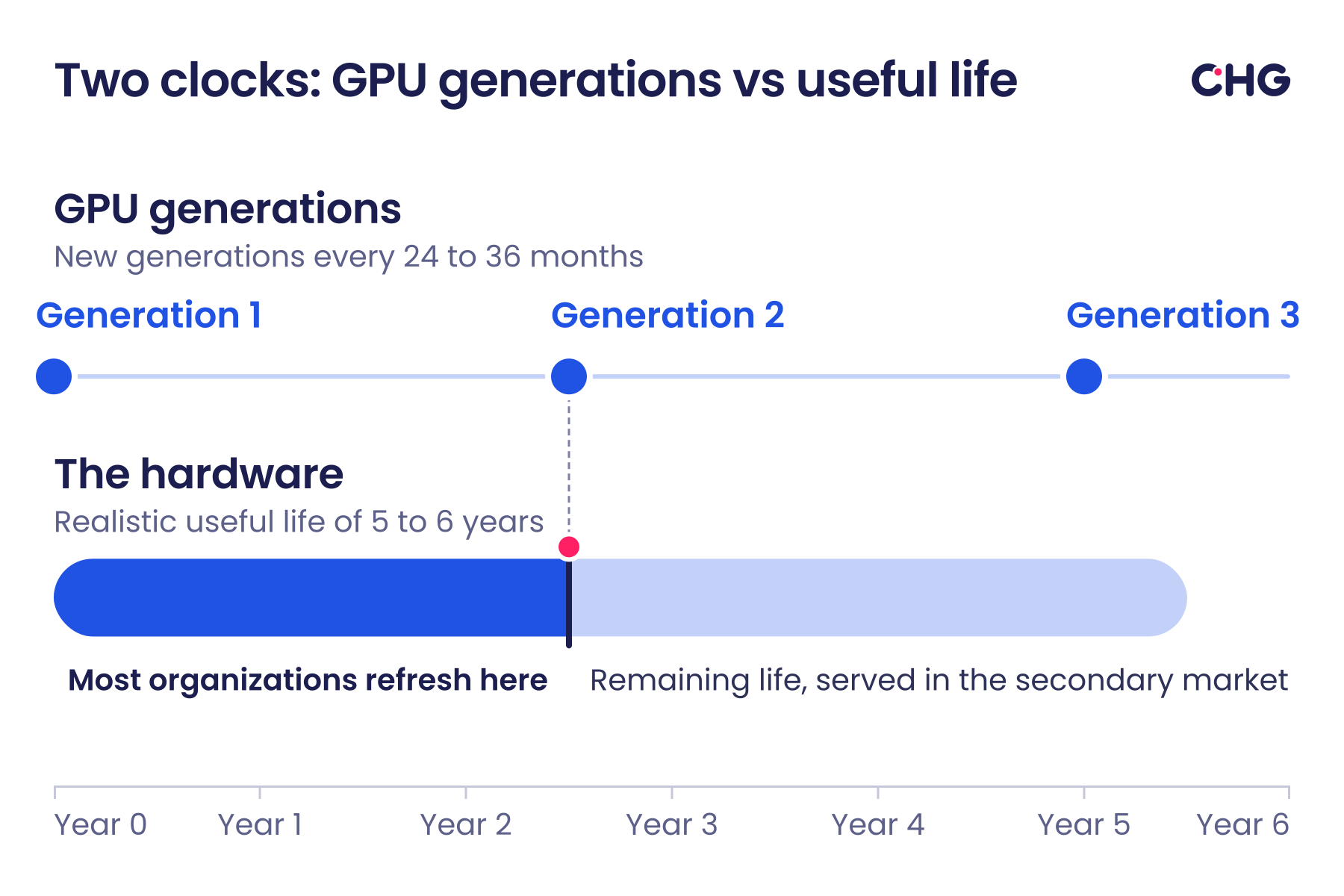
- AI hardware breaks traditional IT capex assumptions: new GPU generations arrive every 24 to 36 months, while the equipment itself can serve for 5 to 6 years.
- Worldwide AI spending is forecast to reach $2.5 trillion in 2026, yet most enterprise AI pilots still fail to show measurable returns.
- A sound framework covers five steps: size the workload, set the accounting treatment, choose the acquisition path, plan the refresh, and plan the exit.
- Residual value is a planning input, not an afterthought. What the hardware is worth at the end of the term changes which acquisition path costs least.
What is AI capital expenditure planning?
AI capital expenditure planning, often shortened to AI capex planning, is the process of budgeting for the physical infrastructure behind artificial intelligence: GPU servers, storage, networking, and the facilities that power and cool them. It covers the full life of the investment, from the initial purchase decision through refresh cycles and eventual resale or retirement.
The term AI capex appears most often in market commentary about hyperscaler spending. Microsoft, Amazon, Google, and Meta dominate those headlines. This article is about the other side of the market: the enterprise that needs to plan its own AI infrastructure budget, usually to run AI workloads on premise or in a colocation facility.
The scale of the market matters even for a single enterprise budget. Gartner forecasts worldwide AI spending to reach $2.5 trillion in 2026, up 44 percent from 2025, with AI infrastructure the largest segment. IDC puts AI infrastructure spending alone at $497 billion in 2026 and expects it to pass $1 trillion by 2029. That demand shapes the prices, lead times, and resale values every buyer plans around.
Why AI capex breaks traditional IT planning
Most IT capital planning assumes a stable pattern. A server is bought, depreciated over five years, and replaced when it slows down. AI infrastructure breaks that pattern in three ways.
First, the generation cycle is faster than the asset life. New GPU generations now arrive every 24 to 36 months. The hardware itself remains productive far longer: in our portfolio experience at CHG-MERIDIAN, a 5 to 6 year useful life for a GPU server is realistic. The gap between those two clocks is the central planning problem. The equipment still works, but the workload has moved on.
Second, prices and availability swing hard. GPU server configurations that cost one amount this quarter can cost meaningfully more or less two quarters later, driven by supply, demand, and new chip launches. A budget set in January can be stale by June.
Third, the return side is unproven for many workloads. An MIT study reported in August 2025 found that 95 percent of enterprise generative AI pilots failed to deliver measurable returns. Gartner expects ROI predictability to improve before enterprises truly scale. Committing large, inflexible capital to uncertain returns is exactly what a CFO is paid to avoid.
A five-step framework for AI capital expenditure planning
The framework below treats AI infrastructure as a lifecycle to manage, not a purchase to approve. Each step produces a decision the next step depends on.
Step one: size the workload, not the wish list
Start from the AI use cases that survived pilot review, and translate them into sustained compute demand. Steady, predictable workloads justify owned or leased on-premise capacity. Spiky or experimental workloads belong in the cloud until they stabilize.
Step two: set the accounting treatment
Decide early whether the spend should sit as capex on the balance sheet or opex through the P&L. This choice affects EBITDA, cash flow timing, and budget ownership, and it narrows which acquisition paths fit. The next section covers this in detail.
Step three: choose the acquisition path
The realistic options are buying outright, leasing, and renting capacity from a cloud or GPU as a service provider. Each path allocates the same three risks differently: technology obsolescence, residual value, and demand uncertainty. Buying concentrates all three on your balance sheet. Cloud transfers them for a premium. Leasing sits between, keeping the hardware on your floor while the lessor carries the residual position.
Step four: plan the refresh before you deploy
Decide at acquisition when and how the equipment will be replaced, not when it ages. Most of our clients choose terms shorter than the hardware's full useful life and return and replace at end of term to stay current. A refresh plan set on day one also disciplines the budget: the next generation is a planned line item, not an emergency request.
Step five: plan the exit
Every GPU server has a second life in the secondary market, and its residual value at the end of your term is real money. Treat that value as an input to the funding decision. A structure that prices in residual value, as a lease does, can carry a lower total cost than ownership, where the resale burden and timing risk stay with you.
Capex vs opex: how should AI infrastructure sit on the books?
The capex vs opex question decides more than accounting presentation. Capital expenditure puts the asset on the balance sheet and spreads cost over its depreciable life. Operating expenditure runs through the P&L as it is consumed, which preserves capital but can cost more over a long horizon.
For AI infrastructure, the mapping is not as clean as buy equals capex, cloud equals opex. Under ASC 842, most equipment leases also come onto the balance sheet as a right-of-use asset and lease liability, though finance and operating leases hit the income statement differently. The practical questions for a CFO are cash flow timing, EBITDA treatment, and how much flexibility each structure leaves when the hardware needs replacing. How ASC 842 treats GPU and AI hardware leases deserves its own article.
A worked example: three ways to fund the same GPU cluster
Take a Fortune 1000 company that has sized its steady AI workload and needs a GPU cluster with a $5 million purchase price, planned around a three-year horizon. The numbers below are illustrative, rounded for clarity.
Buying outright means $5 million of cash out in year one. After three years the company owns three-year-old hardware. It can keep running it toward year five or six, or sell it into the secondary market and carry the timing and price risk of that sale itself.
Leasing over a 36-month term means no large cash outlay and a predictable quarterly payment. Because the lessor prices expected residual value into the rate, the total of payments comes to less than the purchase price. At end of term the company returns the equipment and refreshes to the current generation, which is what most clients choose, or extends the lease for a period if the workload still fits.
Cloud or GPU as a service means no asset at all and maximum flexibility. For a steady, fully utilized workload, however, three years of reserved cloud capacity typically costs well above the hardware's purchase price, because the provider's margin, facilities, and risk transfer are built into the rate. We cover the cost crossover between on-premise AI and cloud in detail in a separate article. Cloud wins on flexibility, not on unit cost at sustained utilization.
| Consideration | Buy outright | Lease (36 months) | Cloud / GPUaaS |
| Year-one cash out | $5M upfront | Payments only | Usage fees only |
| Three-year total cost | Purchase price minus eventual resale | Below purchase price; residual priced in | Typically well above purchase price at steady use |
| Obsolescence risk | Yours | Shared; refresh at end of term | Provider's |
| Residual value | Yours to recover | Lessor's position, priced into rate | None |
| Best fit | Long-lived, stable workloads with strong balance sheet | Steady workloads that need current hardware on premise | Spiky, experimental, or short-term workloads |
The pattern to notice: the steadier and longer-lived the workload, the more value shifts toward structures that keep the hardware close and price in its residual value. The spikier the workload, the more the cloud premium is worth paying.
Common AI capex planning mistakes
Four mistakes come up repeatedly in AI infrastructure budgets.
Sizing to the peak. Building owned capacity for the highest demand spike leaves expensive hardware idle most of the year. Size owned or leased capacity to the steady base and let cloud absorb the spikes.
Ignoring residual value. Treating hardware as worthless at end of life overstates the cost of on-premise options and skews the comparison toward cloud.
Matching the term to the depreciation schedule instead of the technology cycle. A five-year commitment to a fixed configuration ignores that the workload will want new hardware around year three.
Approving the purchase without a refresh and exit plan. The cheapest acquisition can become the most expensive position if nobody owns the question of what happens at end of term.

Where leasing fits in AI capital expenditure planning
Leasing is one path within the broader set of AI infrastructure financing options, and it exists for exactly the risk profile AI hardware presents: high purchase prices, fast technology cycles, and meaningful residual value that a specialist can manage better than a single enterprise can.
Through server and data center equipment leasing, the equipment runs on your premises under your control, payments spread over the term, and the refresh to the next generation is built into the structure rather than bolted on. For a CFO planning AI capital expenditure, that converts the hardest variables in this article, obsolescence and resale, into a fixed, plannable cost.

Talk to us and discover how our expertise can benefit your business.
Frequently asked questions
AI capex is capital expenditure on artificial intelligence infrastructure: GPU servers, storage, networking, and the data center capacity to run them. In market news the term usually refers to hyperscaler spending, but enterprises that run AI workloads on premise carry AI capex of their own.
It covers sizing the compute workload, deciding the accounting treatment, choosing between buying, leasing, and cloud, scheduling the hardware refresh, and planning the end-of-term exit, including the resale or return of the equipment.
It depends on the structure. Purchased hardware is capex. Cloud and GPU as a service fees are opex. Leases are mixed: under ASC 842 most equipment leases sit on the balance sheet, but finance and operating leases flow through the income statement differently.
A GPU server can realistically serve for 5 to 6 years. The planning challenge is that new GPU generations arrive every 24 to 36 months, so the hardware is often replaced for performance reasons before it wears out.
Steady, predictable workloads usually cost least on owned or leased on-premise hardware. Spiky or experimental workloads fit cloud better. Leasing suits companies that want current hardware on premise without carrying residual value and resale risk themselves.
Gartner forecasts worldwide AI spending to reach $2.5 trillion in 2026, with infrastructure the largest segment. IDC forecasts AI infrastructure spending of $497 billion in 2026, passing $1 trillion by 2029.
Most organizations plan refreshes around the GPU generation cycle of 24 to 36 months rather than the hardware's full useful life. Many CHG-MERIDIAN clients choose lease terms shorter than the equipment's useful life and return and replace at end of term.
Residual value is what the hardware is worth on the secondary market at the end of your planning horizon. It matters because a funding structure that prices in residual value, such as a lease, can carry a lower total cost than outright ownership.
It depends on the workload and the discipline of the plan. An MIT study reported in 2025 found 95 percent of enterprise generative AI pilots failed to show measurable returns, which argues for flexible funding structures and staged commitments rather than large upfront bets.
ASC 842 brings most equipment leases onto the balance sheet as a right-of-use asset and a lease liability. The classification as a finance or operating lease then determines how payments appear on the income statement, which affects EBITDA presentation.