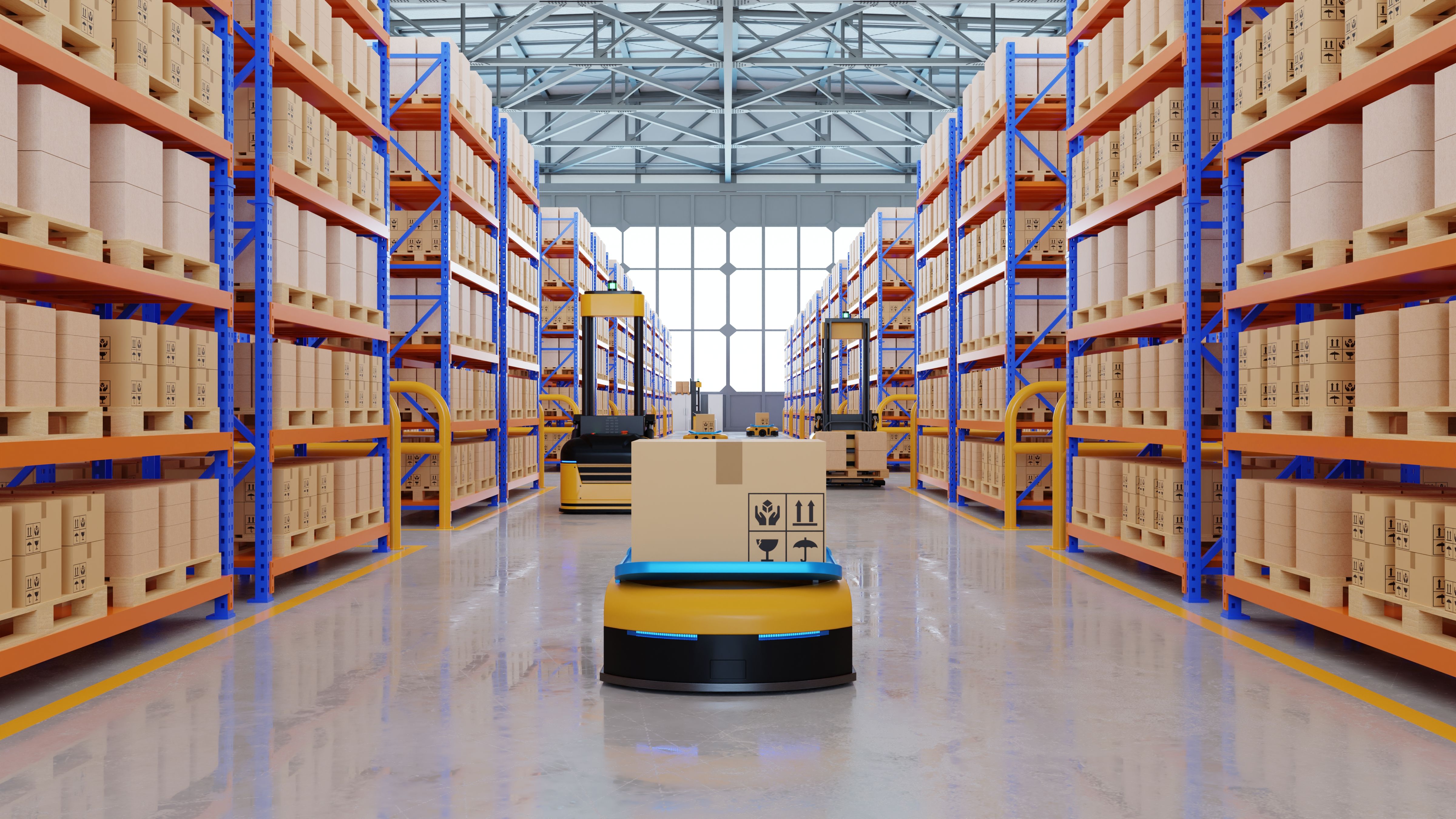
 The Real Cost of AGV and AMR Adoption: How to Finance the Transition
AGVs and AMRs can transform warehouse and manufacturing operations, but the upfront cost stops most companies before they start.
The Real Cost of AGV and AMR Adoption: How to Finance the Transition
AGVs and AMRs can transform warehouse and manufacturing operations, but the upfront cost stops most companies before they start.
Author: Philip Rosenmüller, Head of Fleet Management & Consulting, CHG-MERIDIAN
Published: March 5, 2026
"More times than I can count, we've visited a site where nobody could tell us how many trucks they actually had. That's always where we start."
Philip Rosenmüller, Head of Fleet Management & Consulting, CHG-MERIDIAN

Why Multi-Site Fleet Management Breaks Down
Large fleet management problems don't usually start with a single bad decision. They accumulate. A new facility gets stood up quickly — equipment is ordered, deployed, and forgotten in a local cost center. An acquisition brings another fifty units with their own service history and their own vendor relationships. A site manager starts keeping their own spreadsheet because the corporate system isn't reliable.
The result is predictable across almost every large enterprise:
- No single, trusted inventory of what equipment exists and where
- Maintenance, damage, and repair costs all booked to the same cost center — making it impossible to separate what's normal wear from what's avoidable
- Multiple service providers across sites with inconsistent standards, pricing, and reporting
- Aging equipment kept in service long past the point where it's economical
- Replacement driven by breakdown rather than planning, leading to emergency rentals and reactive spending
Each of these issues is solvable. But they all start from the same place: a lack of visibility.
Get Visibility — Know What You Actually Own
The foundation of any fleet management program is a single, reliable inventory. Not a perfect one — a reliable one. The difference matters, because the pursuit of perfect data often becomes the reason organizations never start.
At minimum, your fleet list should capture for each unit:
- Site and location
- Manufacturer, type, and model
- Year of manufacture and serial number
- Power type (electric, LPG, diesel)
- Current operating hours and planned annual hours
Once that list exists — even at 80–90% accuracy — you can answer questions that are surprisingly difficult today: How old is the fleet on average? Which sites are running equipment hardest? Which units have been sitting idle while another location rents short-term to cover demand?
The practical starting point: pick one format, start with one site, and build from there. The value becomes visible fast — most organizations are surprised by what they find when they see everything in one place for the first time.

Understand What Your Fleet Is Actually Costing You
Most large organizations don't have accurate fleet cost data — not because the costs don't exist, but because they're buried. Maintenance, repairs, damage, and energy all get pooled into a single line item. That makes it impossible to understand the real cost picture, let alone improve it.
A more useful approach is to separate fleet spend into three distinct categories:
- Planned maintenance — scheduled service, filters, inspections, and regular wear items
- Unplanned repairs — components that fail from age or usage, not misuse
- Damage — impacts, bent masts, broken guards — costs that are largely avoidable with training and operational changes
The reason this separation matters: maintenance and repair costs are largely a function of equipment age. Damage costs are a function of how the equipment is operated. These require completely different interventions. When they're combined in one cost center, neither gets addressed properly.
Tracking cost at the unit level — or at minimum at the site level — also makes it possible to compare performance across your network fairly and identify outliers before they become budget surprises.
"Buying a replacement truck in a hurry is always the most expensive way to do it. The companies that plan a year or two ahead get better prices and better terms. It's that simple."
Simon Harrsen, EVP North America, CHG-MERIDIAN

Build a Lifecycle Strategy Instead of Reacting to Breakdowns
In many enterprise fleets, the average equipment age sits at eight to ten years or older. That's not necessarily a problem — if the equipment is still running economically. But in most cases, equipment in that age range has entered its most expensive phase: repair costs accelerate, downtime increases, and energy efficiency deteriorates compared to current models.
A lifecycle strategy replaces reactive decision-making with a planned approach. The core of it is straightforward: set a target age and target operating hours for each equipment type, monitor where each unit sits relative to those thresholds, and use that to build a rolling replacement plan.
With your fleet inventory in place, this becomes a practical exercise. If a unit has 16,000 hours on the clock and you add approximately 2,000 hours per year, you know it hits your 20,000-hour threshold in two years. That unit goes on the replacement plan — rather than showing up as an emergency when it fails mid-shift.
You don't need to run this analysis constantly. A realistic cadence is once per year — a half-day fleet review with operations, purchasing, and finance — with an optional mid-year check focused on upcoming replacements. That rhythm alone converts fleet management from a constant fire drill into an annual, manageable process.
The additional benefit: when you can see upcoming replacements twelve to eighteen months out, you have time to bundle demand across sites, run a proper tender, and negotiate from a position of strength rather than urgency.
Standardize Across Sites
One of the most underestimated cost drivers in multi-site fleet management is fragmentation — too many equipment brands, too many service providers, inconsistent maintenance standards, and no consolidated view of what's being spent or how it's being spent.
When five different local vendors each service a portion of your fleet, you have five different pricing structures, five different parts quality standards, and five different reporting formats that can't be meaningfully compared. A unit that needs a specific repair at one site might cost 40% more than the same repair at another — and you'd never know.
The case for standardization runs across several dimensions:
- Fewer equipment models means simplified parts inventory, faster service, and easier cross-site redeployment when utilization is uneven
- A consolidated service network — ideally a single provider with national coverage — creates consistent pricing, consolidated reporting, and accountability that fragmented local vendors can't deliver
- Standardized processes mean that operators moving between sites, or managers overseeing multiple locations, are working from the same playbook
This doesn't mean every site needs identical equipment — operational requirements vary. But if you have five brands doing essentially the same job at one location, that's a strong signal that procurement has been reactive rather than strategic.

How Financing Structure Affects Fleet Management
The decision to buy or lease equipment is often treated as a purely financial question — a capital allocation decision made by finance with limited input from operations. But how you finance your fleet has a direct impact on how well you can manage it.
The traditional buy-and-hold model — purchasing equipment outright and keeping it on the books for ten to fifteen years — tends to push fleets into their most expensive operating phase. Capital is tied up in depreciating assets, maintenance costs climb as equipment ages, and technology refresh becomes difficult to justify when the balance sheet still shows "serviceable" equipment.
Structured leasing addresses this differently. A well-designed lease aligns the financing term with the optimal lifecycle of the equipment — typically five to seven years for most forklift applications — which means replacement happens before the cost curve steepens. It also converts a capital expenditure into a predictable operating cost, which simplifies budgeting and preserves capital for core business investment.
For multi-site operations specifically, leasing through a single partner also provides a consolidated view of the entire fleet — one contract structure, one reporting framework, one point of accountability across all locations. That's a meaningful operational advantage when you're managing equipment in dozens of facilities.

How CHG-MERIDIAN Approaches Fleet Consultation
The starting point for most organizations isn't a technology investment — it's a clear picture of where they actually stand. That's the basis of CHG-MERIDIAN's fleet consultation process.
The analysis begins with whatever data is available. If a company has reasonably accurate asset lists with equipment age and operating hours, that's often enough to build a meaningful fleet picture from a desk. For more complex situations — multi-site operations with mixed data quality, or organizations that want a ground-level view — CHG conducts on-site assessments across multiple locations simultaneously.
The output is a full total cost of ownership analysis: current fleet status — age profile, utilization, cost structure, lifecycle position — set against what an optimized state would look like. Not a general benchmark, but a specific analysis of that operation, with a clear view of where the savings opportunities sit and what it would take to capture them.
CHG has conducted this type of analysis for multi-site operations managing hundreds of units across the United States. The scope ranges from single-facility reviews to national fleet assessments spanning dozens of locations and multiple equipment categories.
Find Out What Your Fleet Is Actually Costing You
Most enterprises are carrying more fleet cost than they realize — spread across aging equipment, fragmented service contracts, and avoidable operational waste. CHG-MERIDIAN's fleet consultation gives you a clear, data-driven view of your current fleet status and what an optimized state would look like.
The analysis works from your existing data or on the ground at your facilities — whichever gives the clearest picture. Reach out to speak with a CHG fleet specialist.
Frequently Asked Questions
What is forklift fleet management?
Forklift fleet management is the process of tracking, maintaining, and optimizing a company's forklift assets to reduce costs and improve operational performance. It encompasses equipment inventory, maintenance scheduling, cost analysis, operator oversight, and lifecycle planning — the combination of which helps organizations make informed decisions about when to repair, redeploy, or replace equipment.
How do you manage forklifts across multiple warehouse locations?
Effective multi-site forklift management starts with a single consolidated inventory covering all locations. From there, standardizing service providers, equipment models where possible, and maintenance processes creates consistency across sites. A centralized data system — whether a fleet management platform or a well-structured asset register — gives managers visibility across the full network rather than relying on site-by-site reporting.
What data do you need to manage a large forklift fleet effectively?
The core data points are equipment identity (make, model, serial number, year), operating hours, maintenance and repair cost history, utilization rate, and site location. With those fundamentals in place, you can track cost per operating hour, identify replacement candidates, compare performance across sites, and build a forward-looking replacement plan. Telematics can add real-time utilization and impact data on top of that foundation.
When should you replace forklifts in a large fleet?
Replacement timing should be driven by a combination of age, operating hours, and cost trajectory — not by equipment failure. Most forklift applications have an economical operating life of five to seven years or 15,000 to 20,000 hours, depending on duty cycle. When repair costs begin climbing sharply relative to operating hours, that's the signal that a unit has passed its cost-effective lifecycle. Building a lifecycle strategy around these thresholds converts replacement from a reactive expense into a planned, budgeted process.
Is it better to lease or buy forklifts for a large fleet?
For large enterprise fleets, structured leasing typically aligns better with how good fleet management actually works. Leasing ties the financing term to the equipment's optimal lifecycle, which prevents the buy-and-hold pattern that keeps aging, expensive equipment in service too long. It also converts capex to predictable opex, simplifies budgeting, and — when managed through a single leasing partner — provides consolidated reporting and accountability across all sites. Whether leasing is the right structure depends on a company's specific capital position, tax situation, and operational requirements.
Get in Touch
Simon Harrsen leads CHG-MERIDIAN's North American operations, helping organizations optimize technology investments through smarter lifecycle management. Connect with him to discuss how your business can reduce costs and increase flexibility.

Simon Harrsen
Executive Vice President, North America
Stay Connected
Learn more
The Real Cost of AGV and AMR Adoption: How to Finance the Transition
AGVs and AMRs can transform warehouse and manufacturing operations, but the upfront cost stops most companies before they start.
 Guide: Leasing Material Handling Equipment
Leasing material handling equipment is less about financing and more about building a strategy that keeps your operation competitive without locking capital into assets that depreciate the moment they hit your floor.
Guide: Leasing Material Handling Equipment
Leasing material handling equipment is less about financing and more about building a strategy that keeps your operation competitive without locking capital into assets that depreciate the moment they hit your floor.
 Remarketing for industrial
What do you do with your industrial technology at the end of its useful life? Are you using the option to remarket it? Learn how to implement an efficient remarketing solution that is both cost-efficient and sustainable.
Remarketing for industrial
What do you do with your industrial technology at the end of its useful life? Are you using the option to remarket it? Learn how to implement an efficient remarketing solution that is both cost-efficient and sustainable.