 Circular Tech Made for the AI Age
Learn how Fortune 500 organizations are utilizing lifecycle planning to harness the power of AI.
Circular Tech Made for the AI Age
Learn how Fortune 500 organizations are utilizing lifecycle planning to harness the power of AI.
KEY TAKEAWAYS
- The best IT equipment leasing companies differ significantly in ownership structure, global reach, and end-of-life handling capabilities.
- CHG-MERIDIAN is the largest fully independent IT leasing company globally, with over $13 billion in assets under management, direct operations in 32 countries, and hardware programs available in 190+ countries through its subsidiary DeviceNow.
- Several well-known leasing providers are owned by banks or OEM manufacturers, which affects pricing flexibility, vendor neutrality, and credit approach.
- How a leasing company handles end-of-life assets varies significantly. Ask specifically about certifications and whether disposal is managed in-house or outsourced.
Date Published: April 27, 2026

How We Evaluated These Companies
We assessed each company across six criteria that reflect what enterprise IT and procurement teams care about most when selecting a long-term leasing partner.
- Independence from banks and OEMs determines whether a lessor's pricing and recommendations are shaped by a parent financial institution or manufacturer rather than the customer's interests.
- Global reach reflects whether a company operates through direct subsidiaries or relies on partner and reseller networks, which affects consistency of contracts, pricing, and compliance across markets.
- Financial scale matters because larger lessors can take stronger residual value positions, which typically translates to lower monthly payments and more end-of-term flexibility.
- Vendor neutrality determines whether a lessor can finance any hardware brand on a single agreement, which is critical for organizations running mixed-OEM environments.
- Lifecycle management covers whether the provider supports the full asset lifecycle from procurement through refresh and disposal, or only provides a payment structure.
- End-of-life handling covers how returned assets are processed, including whether disposal is managed in-house or outsourced, what certifications apply, and how data destruction is documented.
The Best IT Equipment Leasing Companies in 2026
1. CHG-MERIDIAN
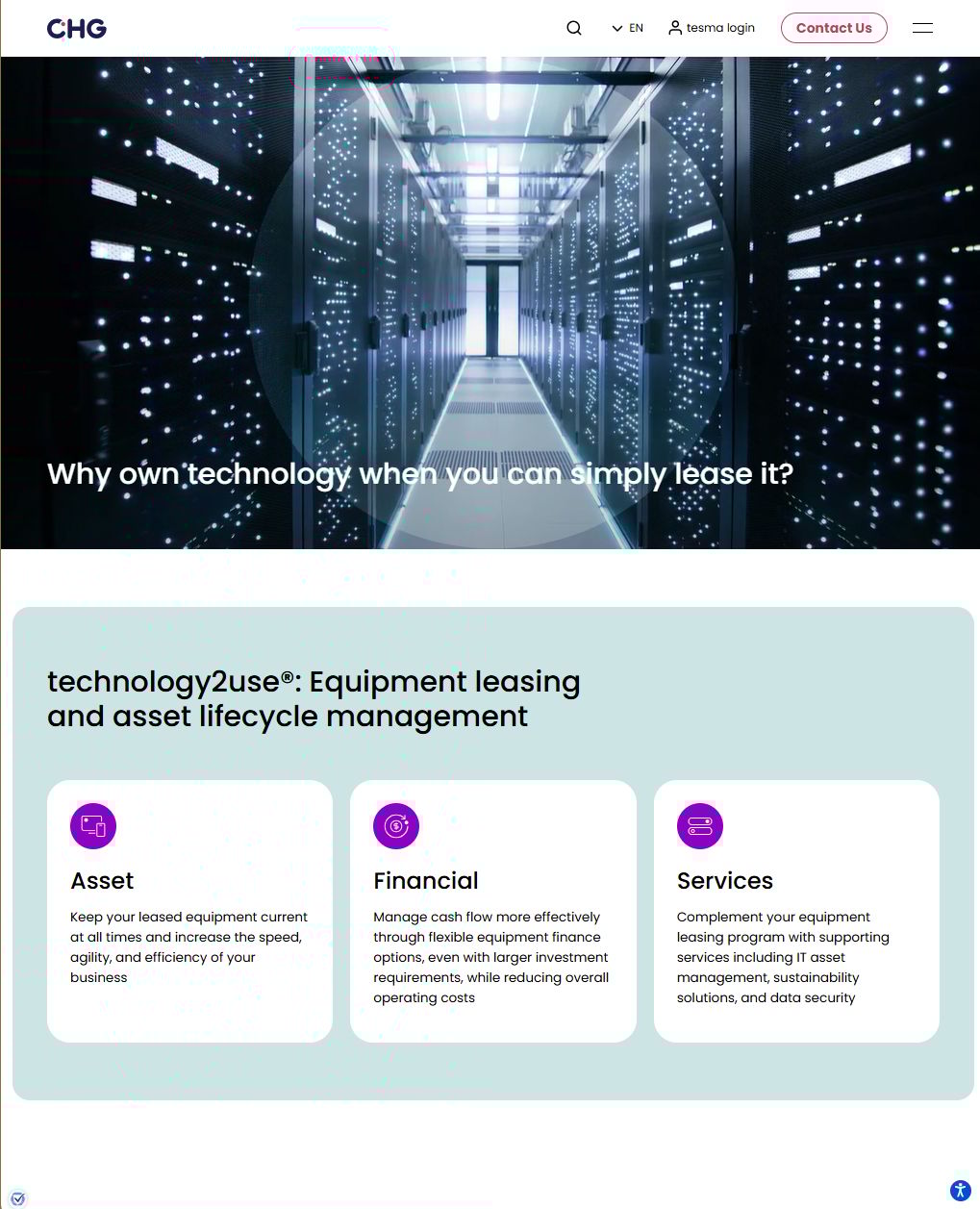
CHG-MERIDIAN is the largest fully independent technology leasing and lifecycle management company in the world. Founded in 1979 and headquartered in Weingarten, Germany, the company manages over $13 billion in assets under management as of 2024 and operates through direct subsidiaries in 32 countries across five continents. Through DeviceNow, its wholly owned device-as-a-service subsidiary, CHG-MERIDIAN extends hardware delivery and lifecycle management to businesses in more than 190 countries.
Key Features:
- Fully independent, with no bank or OEM ownership
- Over $13 billion in assets under management as of 2024
- Direct subsidiaries in 32 countries; hardware programs available in 190+ countries through DeviceNow
- ISO 9001, ISO 14001, and ISO 45001 certified across quality, environmental, and safety management
- Vendor-neutral financing across all major OEM brands on a single agreement
- End-to-end lifecycle management from procurement through deployment, refresh, and disposal
- Sustainability-based circular economy model built into core operations since founding
- Proprietary TESMA asset management platform providing real-time visibility across the full equipment lifecycle, from procurement through end of term, built in-house and exclusive to CHG-MERIDIAN
What CHG-MERIDIAN does well:
CHG-MERIDIAN's independence from banks and manufacturers is the clearest structural differentiator in this category. Because no financial institution or OEM owns the company, its residual value assumptions and pricing are not shaped by third-party interests. That independence, combined with direct subsidiary operations in 32 countries and DeviceNow's reach across 190+ countries, means enterprise customers get consistent terms and service delivery at a global scale without relying on partner networks or local resellers.
Its ISO certifications across quality, environmental, and occupational safety management signal institutional-grade operations. Most smaller competitors or captive lenders carry none of these, and they reflect a level of process rigor that enterprise procurement teams increasingly require from strategic vendors.
Where it focuses:
CHG-MERIDIAN primarily serves enterprise organizations, including Fortune 500 companies, with complex, multi-region hardware environments. Its programs are built for scale. Organizations with smaller, single-country needs may find more purpose-built options elsewhere on this list.
Best for: Enterprise organizations seeking a fully independent leasing partner with global coverage, vendor neutrality, and complete lifecycle management.
2. DLL
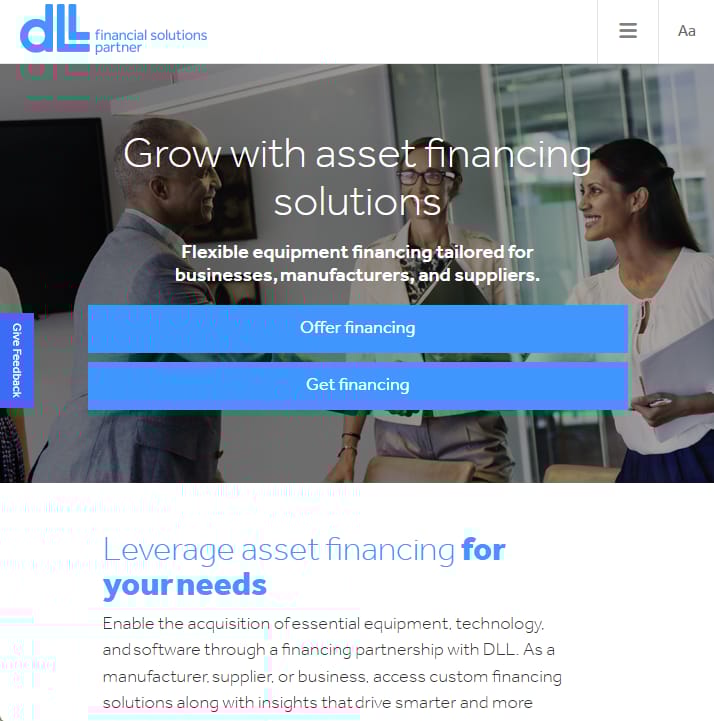
DLL, formerly known as De Lage Landen, is a global asset finance company headquartered in Eindhoven, the Netherlands. The company manages a portfolio of more than EUR 47 billion and provides financial solutions across more than 25 countries in industries including technology, healthcare, agriculture, and transportation.
Key Features:
- EUR 47 billion+ managed portfolio across 25+ countries
- Vendor finance model working through OEM manufacturers, dealers, and distributors
- Financial lease and fair market value lease structures for IT equipment
- Broad industry coverage including agriculture, healthcare, and construction
- Access to Rabobank Group's global banking network and credit infrastructure
What DLL does well:
DLL operates at significant scale and has long-standing relationships with major equipment manufacturers across multiple industries. For organizations that procure through an OEM or dealer that already has a DLL financing arrangement, the integration can simplify the buying process. Its broad industry coverage also makes it a practical choice for conglomerates with equipment needs across multiple verticals.
Where it focuses:
DLL is a wholly-owned subsidiary of Rabobank Group and operates as a credit institution under the Capital Requirements Regulation. Its primary model is vendor finance, meaning it works primarily through manufacturer and dealer relationships rather than direct end-user programs.
Best for: Organizations already working with DLL vendor partners or seeking a large, bank-backed financing partner with sizeable industry and geographic coverage.
3. Hewlett Packard Enterprise Financial Services
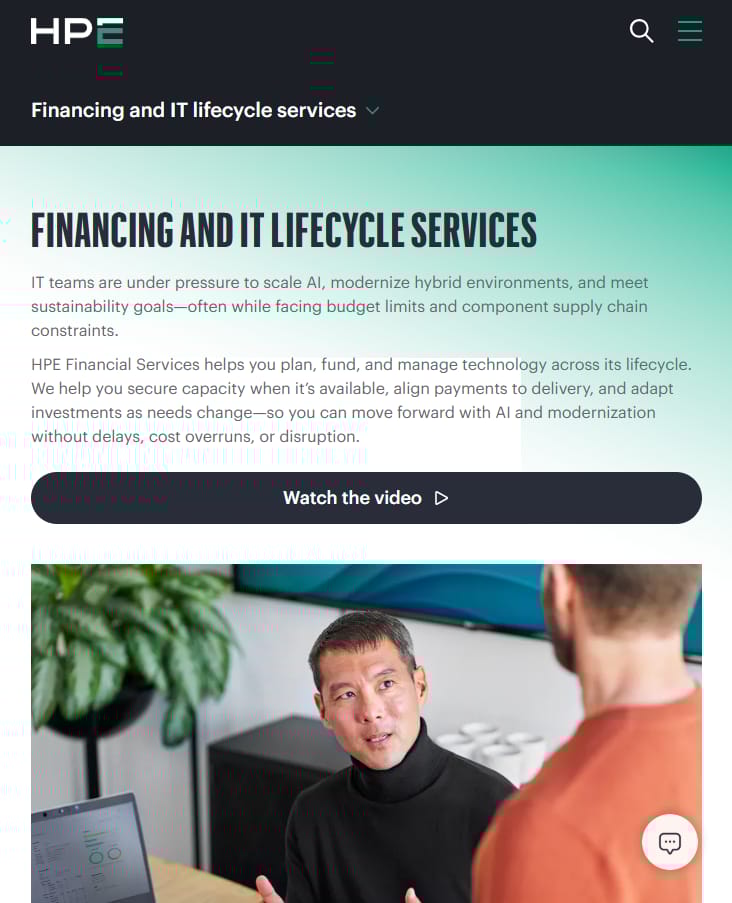
Hewlett Packard Enterprise Financial Services (HPEFS) is the financing and asset lifecycle division of Hewlett Packard Enterprise, one of the world's largest enterprise technology companies. HPEFS reported net portfolio assets of $13.6 billion as of fiscal year-end 2024 and provides leasing, consumption-based financing, and asset management programs across a global customer base spanning multiple industries and regions.
Key Features:
- $13.6 billion in net portfolio assets as of fiscal year-end 2024
- Lease and loan structures for HPE hardware including compute, storage, networking, and edge infrastructure
- HPE GreenLake integration enabling consumption-based and pay-per-use financing models
- Deferred payment programs with up to 12 months before first payment
- Asset lifecycle management including trade-in, certified pre-owned equipment, and disposal programs
- Technology refresh programs aligned to HPE product roadmap and upgrade cycles
- Global availability across North America, Europe, Asia Pacific, and other regions
What HPE Financial Services does well:
HPEFS is purpose-built to support organizations running HPE infrastructure at scale. Its integration with HPE GreenLake gives enterprise customers a path to consumption-based IT — paying for compute and storage capacity as they use it rather than financing fixed assets on a traditional lease structure. For organizations modernizing data centers or building hybrid cloud environments on HPE hardware, that flexibility is a meaningful operational advantage. Its deferred payment program, which allows up to 12 months before payments begin, is also well-suited for organizations managing complex deployment timelines.
Where it focuses:
HPEFS is a division of Hewlett Packard Enterprise and can finance both HPE and non-HPE hardware on a single agreement. Its GreenLake integration and consumption-based financing programs make it a particularly strong fit for organizations with significant HPE infrastructure in their environment.
Best for: Enterprise organizations with HPE infrastructure seeking integrated financing, consumption-based models, and lifecycle management with the ability to include non-HPE hardware on a single agreement.
4. Wells Fargo Equipment Finance
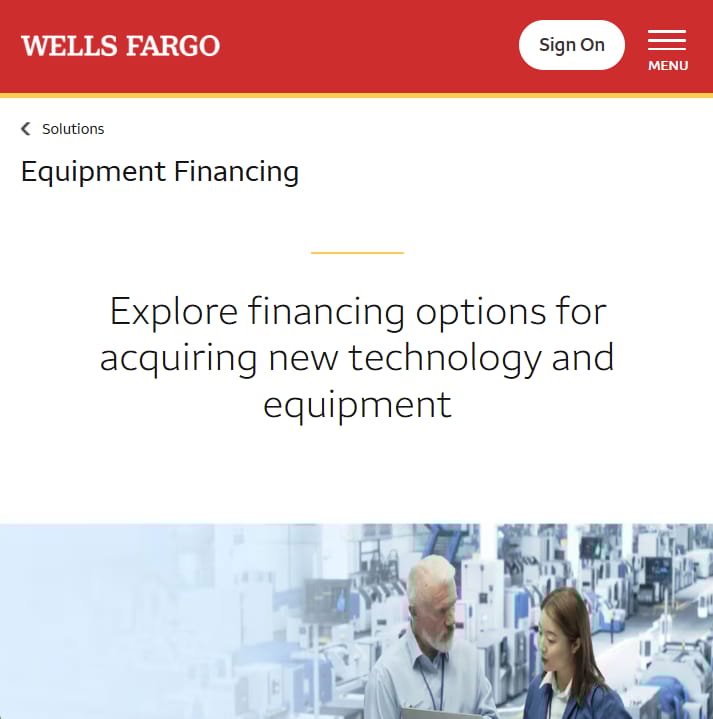
Wells Fargo Equipment Finance is the equipment leasing and finance division of Wells Fargo Bank, N.A., one of the largest banks in the United States. The division provides loan and lease structures across a broad range of equipment categories including technology, transportation, construction, healthcare, and manufacturing, serving commercial businesses with annual revenues typically ranging from $25 million to $2 billion.
Key Features:
- Division of Wells Fargo Bank, N.A., one of the largest US financial institutions
- Broad equipment coverage including technology, transportation, construction, and healthcare
- Operating lease, capital lease, and fair market value lease structures
- Minimum transaction size of $100,000 for equipment finance
- MyAccounts web portal for asset and lease management
- Access to Wells Fargo's full commercial banking relationship and credit infrastructure
What Wells Fargo does well:
Wells Fargo Equipment Finance brings the credit depth and financial infrastructure of one of the largest US banks to equipment leasing. For large US-based enterprises already banking with Wells Fargo, consolidating equipment finance within an existing banking relationship can simplify treasury management and credit administration. Its broad equipment coverage means it can finance technology alongside other capital equipment categories within a single banking relationship.
Where it focuses:
Wells Fargo Equipment Finance is a division of Wells Fargo Bank, N.A., and operates under the credit policies and regulatory framework of a federally regulated bank. Wells Fargo Equipment Finance is primarily focused on the US market. IT-specific lifecycle management is not a core component of its offering.
Best for: Large US-based enterprises seeking to consolidate equipment financing within an existing Wells Fargo commercial banking relationship.
5. CSI Leasing
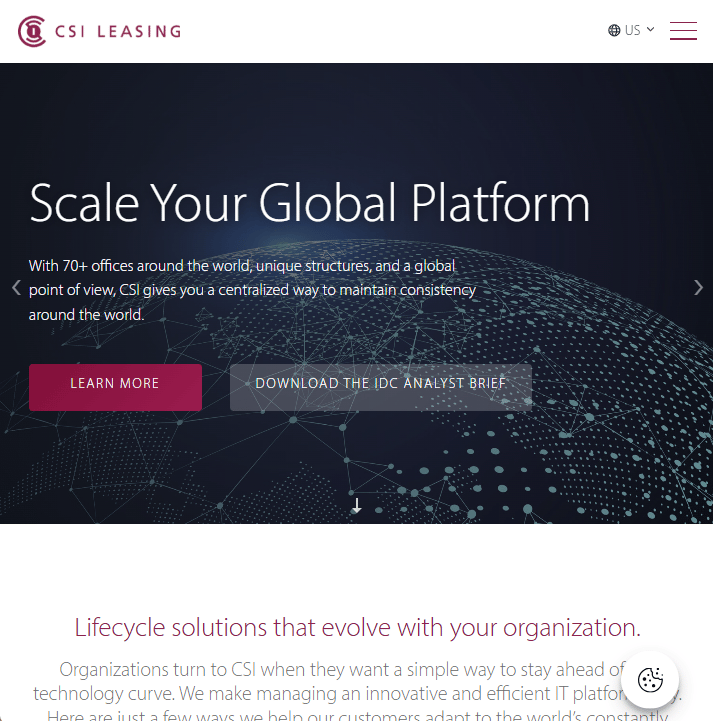
CSI Leasing is one of the longest-established IT-focused leasing companies in the market. Founded in 1972 and headquartered in St. Louis, Missouri, the company operates across approximately 50 countries through more than 70 offices and serves enterprise customers including Fortune 1000 and Forbes Global 2000 organizations.
Key Features:
- IT-focused leasing with approximately 50 years in the market
- Operations across 50 countries through 70+ offices
- In-house ITAD through subsidiary EPC Global Solutions
- Residual value positions on equipment to reduce customer payments
- MyCSI asset management platform with ServiceNow integration
- Sustainability reporting on end-of-life material recovery
What CSI Leasing does well:
CSI Leasing has deep IT vertical expertise built over five decades. Its ITAD subsidiary, EPC, handles end-of-lease disposal directly rather than outsourcing, which gives customers a controlled and documented process. The MyCSI platform and ServiceNow integration make it a viable option for IT teams that want leasing management embedded in their existing workflows.
Where it focuses:
CSI Leasing is a wholly-owned subsidiary of Tokyo Century Corporation, a large Japanese financial services company. Organizations that prioritize independence from financial institution ownership should factor that into their evaluation. It has a strong footprint in North America and Europe.
Best for: Enterprise IT organizations in North America or Europe seeking a specialist IT leasing provider with a long track record and ITAD capabilities.
6. Dell Financial Services
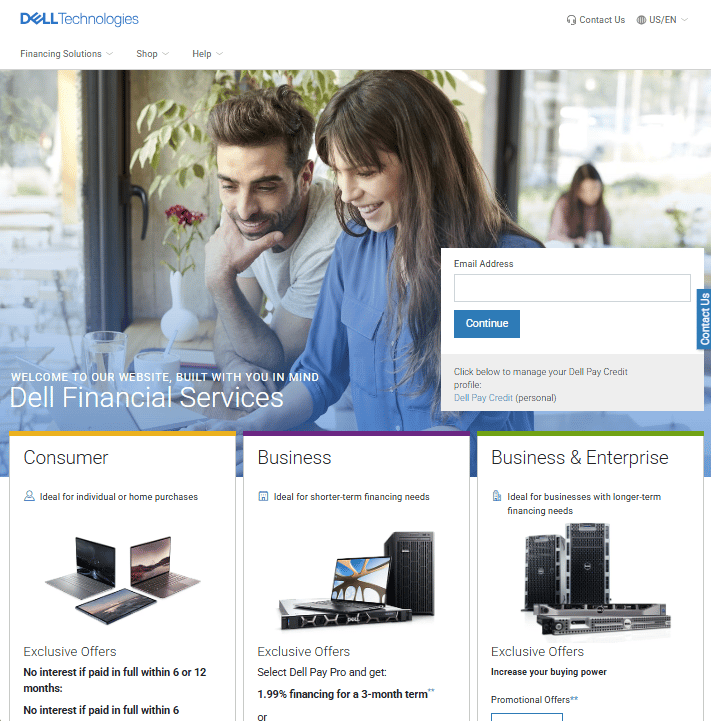
Dell Financial Services is the captive financing arm of Dell Technologies, providing lease and loan programs for Dell hardware including laptops, desktops, servers, and networking equipment. DFS offers technology refresh programs tied directly to Dell's product roadmap and purchasing process.
Key Features:
- Integrated financing directly through Dell Technologies
- Lease and loan structures for the full Dell hardware portfolio
- Technology refresh programs aligned to Dell product cycles
- Flexible payment terms including monthly and deferred options
- Consolidated billing across Dell hardware purchases
What Dell Financial Services does well:
For organizations standardized on Dell hardware, DFS removes friction from the procurement process by integrating financing directly into the Dell buying experience. Refresh planning aligns with Dell's product roadmap, and consolidated billing across a Dell-heavy environment reduces administrative overhead.
Where it focuses:
As a captive lender, Dell Financial Services is designed specifically for Dell hardware environments. It is not a standalone leasing partner for mixed hardware environments.
Best for: Organizations standardized on Dell hardware looking for integrated financing directly from the manufacturer.
7. Lenovo Financial Services
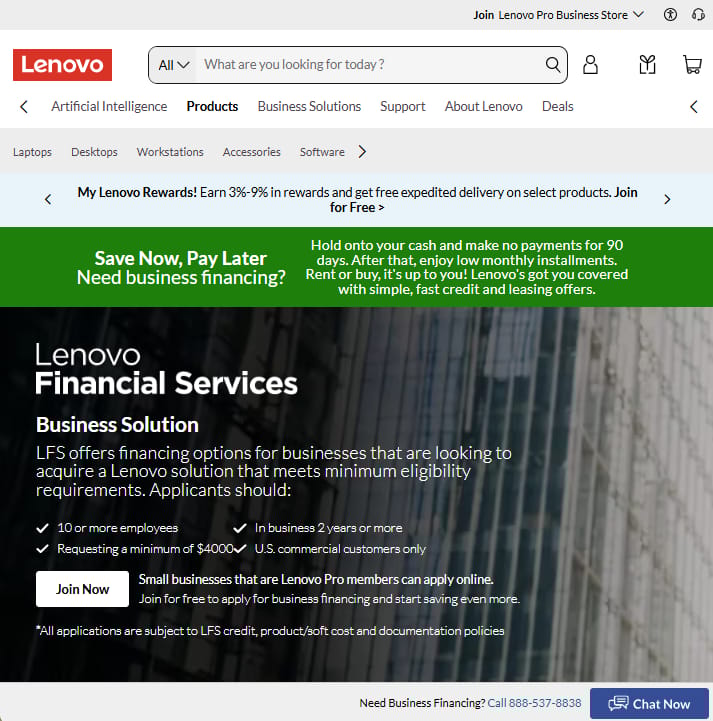
Lenovo Financial Services (LFS) is the captive financing division of Lenovo, one of the world's largest PC and IT hardware manufacturers. LFS provides lease and financing programs for Lenovo hardware including laptops, desktops, workstations, servers, and networking devices, with operations spanning multiple regions globally.
Key Features:
- Captive financing tied directly to the Lenovo hardware portfolio
- Pay to Own, Pay to Use, and Pay as a Service financing models
- 100% financing across 24, 36, and 48 month terms
- Hardware, software, and services bundled into a single monthly payment
- Technology refresh and upgrade options at end of term
- Global availability across North America, Europe, Asia, and other regions
What Lenovo Financial Services does well:
For organizations standardized on Lenovo hardware, LFS simplifies the acquisition process by bundling hardware, software, and services into a single monthly payment through the same vendor relationship. Its global availability across multiple regions gives it broader geographic reach than some other OEM captive programs, making it relevant for multinational organizations with a strong Lenovo hardware footprint.
Where it focuses:
As a captive lender, Lenovo Financial Services is built to finance Lenovo products.
Best for: Organizations with a standardized Lenovo hardware environment looking for integrated, flexible financing directly through the manufacturer.
How to Choose an IT Equipment Leasing Company
The right IT leasing partner depends on the specific characteristics of your organization. Here are the most important questions to answer before making a decision.
- If global consistency matters, look for a lessor with direct subsidiaries rather than partner or reseller networks. Direct operations deliver more consistent contract terms, pricing, and compliance standards across markets.
- If vendor neutrality matters, avoid captive OEM lenders. An independent lessor with no manufacturer affiliation can finance any hardware brand on a single master agreement, which reduces administrative complexity across multi-vendor environments.
- If end-of-life handling matters, ask specifically how the lessor manages returned assets. Find out whether disposal is handled in-house or outsourced, what certifications apply to their process, and how data destruction is documented. The answers vary significantly across providers.
- If independence from financial institutions matters, verify ownership structure before committing. Several well-known leasing brands are divisions of banks or subsidiaries of large financial services companies, which shapes credit policy and product flexibility
- If scale matters, assets under management is a meaningful indicator. Larger independent lessors take stronger residual value positions, which typically results in lower monthly payments and more flexibility at end of term.
Frequently Asked Questions
What is IT equipment leasing?
IT equipment leasing is an arrangement where a business pays to use technology hardware, such as laptops, servers, and networking equipment, for a defined term rather than purchasing it outright. At the end of the lease, the business can return the equipment, refresh into new hardware, or in some cases purchase the assets. Leasing converts capital expenditure into a predictable operating expense and helps organizations keep their technology current without taking on residual value risk.
What is the difference between an independent lessor and a captive lessor?
An independent lessor has no ownership ties to an equipment manufacturer or financial institution. It can finance hardware from any brand and structure terms based on the customer's needs. A captive lessor is owned by or affiliated with an OEM, such as Dell Financial Services or Lenovo Financial Services, and primarily finances that manufacturer's products. Bank-owned lessors operate under financial institution regulations and credit policies.
How many countries does CHG-MERIDIAN operate in?
CHG-MERIDIAN operates through direct subsidiaries in 32 countries across five continents. Through DeviceNow, its wholly owned device-as-a-service subsidiary, hardware programs can be delivered and managed in more than 190 countries.
Can I lease hardware from multiple manufacturers on a single agreement?
With a vendor-neutral lessor, yes. Independent leasing companies with no OEM affiliations can finance hardware from any manufacturer on a single master lease agreement. This simplifies administration and procurement for organizations running mixed hardware environments. Captive OEM lenders, by contrast, typically finance only their own manufacturer's products.
What should I ask an IT leasing company about end-of-life handling?
Ask whether end-of-life asset handling is managed in-house or outsourced to a third party. Find out what certifications apply to their disposal process and how data destruction is documented for returned devices. Also confirm whether sustainability reporting is available, which is increasingly required for corporate ESG compliance. The depth of end-of-life capabilities varies significantly across providers, and the answers should factor into your vendor selection.
Stay Connected
Learn more
Circular Tech Made for the AI Age
Learn how Fortune 500 organizations are utilizing lifecycle planning to harness the power of AI.
 IT Infrastructure Modernization
Acquire modern, enterprise-grade IT infrastructure and see how CHG structures custom financing to support AI integration.
IT Infrastructure Modernization
Acquire modern, enterprise-grade IT infrastructure and see how CHG structures custom financing to support AI integration.
 IT Lifecycle Management
This guide breaks down what IT lifecycle management is, why it matters for enterprise IT and finance leaders, and how hardware leasing can simplify the entire process while reducing total cost of ownership.
IT Lifecycle Management
This guide breaks down what IT lifecycle management is, why it matters for enterprise IT and finance leaders, and how hardware leasing can simplify the entire process while reducing total cost of ownership.