
What to Review Before Your 2027 Budget Is Finalized
Start with a clear-eyed inventory, not assumptions. Key questions for IT and finance leaders to align on together:
- Asset age and condition: Which devices, servers, and equipment are approaching (or past) their optimal refresh point?
- Utilization data: What's underused, overprovisioned, or sitting idle
- Service Expiries: Warranty, service, or maintenance agreements expiring in 2027
- Total cost of ownership (TCO): Not just purchase price, but maintenance, energy, downtime risk, and support costs.
- Sustainability commitments: Does your equipment plan align with corporate ESG or circular economy targets?
This is also the moment to bring IT and finance to the same table. Budget cycles too often separate these conversations — IT flags what's needed technically, finance evaluates it in isolation. Reviewing lifecycle data together, before numbers are submitted, avoids costly surprises in Q1.

Aging Hardware and Upcoming Refresh Cycles
Hardware doesn't fail on a convenient schedule. Devices and infrastructure that are three, four, or five years old are more prone to slower performance, higher failure rates, and security vulnerabilities — all of which quietly drive-up support costs even before a formal failure occurs.
Mapping refresh cycles against your 2027 fiscal calendar now means you can budget for replacement proactively, rather than reacting to a break-fix emergency mid-year.
Rising Equipment Costs
Technology procurement costs have been on an upward trend, driven by global supply chain pressures, currency fluctuations, and increased demand for higher-performance components (especially for AI-capable hardware). For Canadian organizations budgeting in CAD while purchasing largely USD-denominated equipment, this adds another layer of cost volatility to plan for.
Locking in financing terms and equipment access now — rather than waiting until Q1 — can help insulate your budget from further price increases and currency swings.
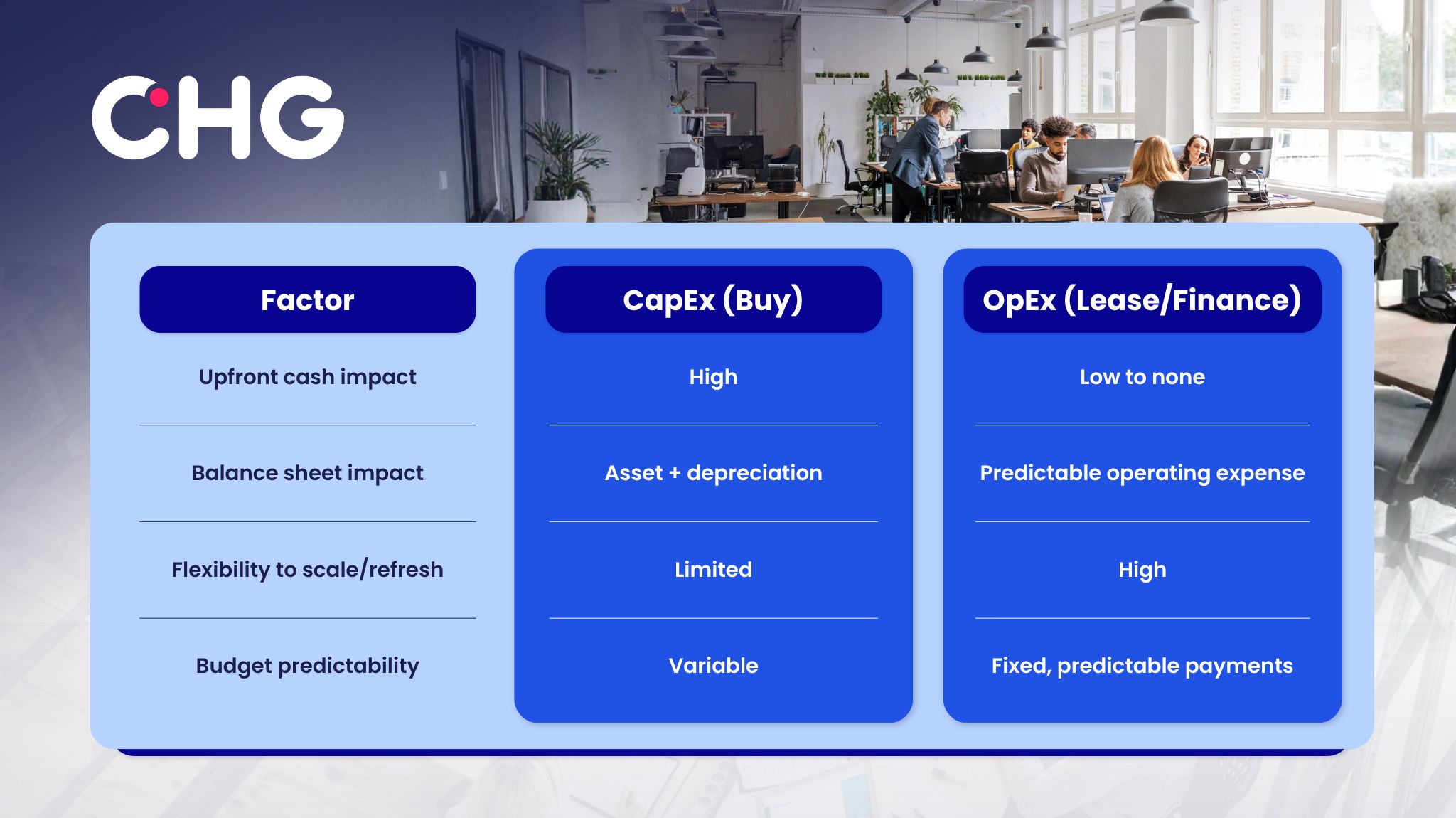
CapEx vs. OpEx: What Fits Your 2027 Strategy?
This is one of the most consequential decisions in the budget process. Some considerations are in the image below.
Many organizations are shifting toward OpEx models specifically because they preserve capital for innovation projects — including AI — while keeping technology current through structured refresh cycles.
How Much Capital Is Tied Up in Existing Equipment?
This is a question worth quantifying before budget season, not after. Owned equipment sitting on the balance sheet represents capital that could otherwise be redirected toward growth initiatives.
An end-to-end asset management approach gives finance leaders visibility into exactly how much value is tied up in current infrastructure — and what could be freed up through remarketing, refinancing, or a shift to usage-based models.
Planning for AI-Related Infrastructure
AI adoption is pushing new demands onto IT infrastructure: higher-performance servers, increased storage, greater power and cooling requirements. Before 2027 budgets are locked, it's worth asking:
- Does current infrastructure support planned AI workloads, or will it need significant upgrades?
- Should AI-specific hardware be purchased outright, or financed to preserve flexibility as the technology — and your needs — evolve quickly?
- How will this equipment be managed and refreshed as AI hardware cycles are likely to move faster than traditional IT refresh timelines?
Building AI infrastructure costs into the budget now — even as estimates, not final numbers — prevents mid-year scrambling for unbudgeted capital.

What Happens to Equipment at End of Life?
End-of-life planning is often an afterthought, but it has real budget and compliance implications. Questions to resolve before year-end:
- Is there a defined process for secure data wiping and decommissioning?
- Will retired equipment be resold, remarketed, or recycled?
- Are there circular economy commitments this needs to support?
- Who owns this process internally, and is it budgeted for?
Unmanaged end-of-life equipment creates data security risk, environmental liability, and missed value-recovery opportunities — all of which are easier to plan for proactively than to fix retroactively.
Why Lifecycle Planning Should Happen Before Budget Approval
The organizations that manage technology costs well aren't the ones with the biggest budgets — they're the ones who plan lifecycle events before the budget is finalized, not after.
When refresh timing, financing structure, and end-of-life plans are mapped out in advance:
- Budget requests are based on real data, not estimates
- Capital stays available for strategic priorities like AI
- Equipment costs become predictable operating expenses
- There's a clear plan for what happens to equipment when it's retired
This is the core of what equipment lifecycle management delivers — visibility and structure across the full useful life of your technology, tied to financing that flexes with your organization's needs.
How CHG-MERIDIAN Supports 2027 Budget Planning
CHG-MERIDIAN Canada helps organizations plan technology costs with confidence by combining:
- Flexible financing models that shift equipment costs from CapEx to predictable OpEx
- Lifecycle management across the full useful life of IT, industrial, and healthcare technology
- tesma®, our platform for managing device fleets — commercial and technical data in one place, for full transparency into what you have, its condition, and what's coming due
- Structured end-of-life support, including secure decommissioning and remarketing, aligned with circular economy principles