Section 1: What's Driving the Real Cost of AI Infrastructure?
The sticker price is just the beginning
Modern AI workloads, from large language model training to real-time inference, demand specialized hardware: high-density GPU servers, ultra-fast networking fabric, and substantial storage. A single NVIDIA H100 GPU can cost upwards of USD $30,000, and enterprise AI clusters typically require dozens to hundreds of units. For Canadian organizations purchasing in USD, currency exposure adds another layer of cost unpredictability.
But the hardware itself is only part of the picture. Total cost of ownership (TCO) for AI infrastructure includes:
- Power and cooling infrastructure: AI servers generate significant heat and draw substantial power, often requiring data centre upgrades
- Networking: High-bandwidth interconnects (like InfiniBand or 400GbE) are essential for GPU-to-GPU communication and add considerable cost
- Integration and deployment: Professional services, rack installation, and software stack configuration
- Ongoing maintenance and support: Vendor warranties, firmware updates, and break-fix support contracts
- Staff and expertise: Skilled infrastructure engineers to manage and optimize AI hardware
Why traditional capex models break down for AI
Legacy IT refresh cycles ran on three-to-five-year timelines, reasonable for servers and storage that evolved slowly. AI hardware is different. GPU generations are turning over every 12–18 months, meaning hardware purchased today may be technically obsolete within two years. Locking millions of dollars into a depreciating asset and then repeating that cycle, puts enormous strain on capital budgets and creates a strategic liability: you're always running on yesterday's technology.
For CFOs, this is a balance sheet problem. For CIOs, it's an agility problem. For procurement teams, it's a total cost of ownership problem. Strategic financing addresses all three.

Section 2: What Are the Paths to Funding AI Infrastructure?
Every enterprise faces the same fundamental choice when building AI infrastructure: buy, rent, or finance. Each path has merit, and meaningful trade-offs.
Path 1: Buy Outright (Capex Purchase)
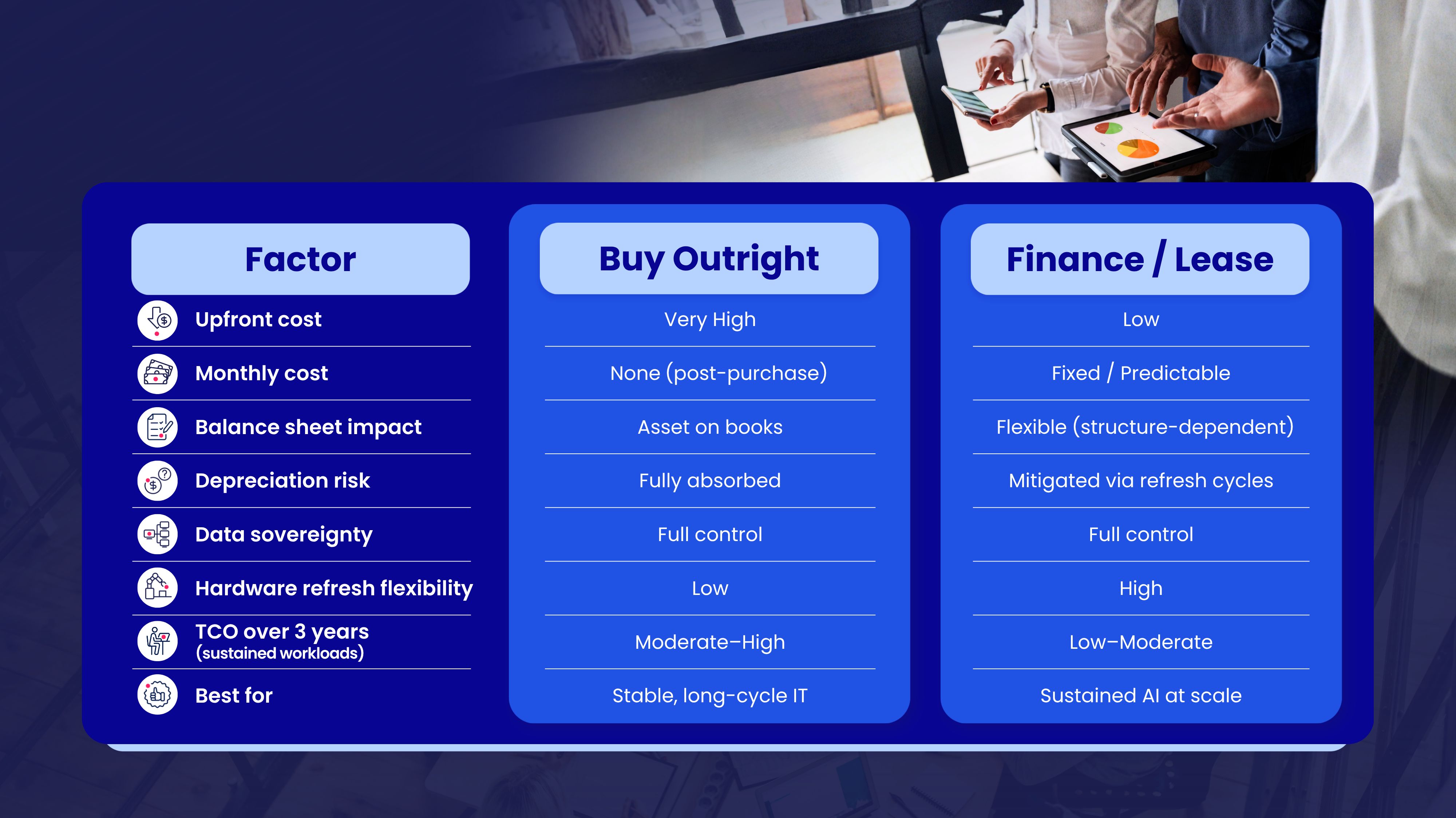
Purchasing AI hardware outright gives you full ownership and maximum control. There are no ongoing financing costs, and for organizations with strong balance sheets and stable AI roadmaps, it can make sense.
The downside: You absorb 100% of the depreciation risk. If a new GPU generation renders your hardware less competitive in 18 months, which is a real possibility, you've tied up capital in a depreciating asset with limited resale value. For most enterprises, this is a poor trade-off.
Path 2: Finance / Lease AI Infrastructure
Technology financing, leasing or structured financing arrangements through a specialist provider, converts a large upfront capex expenditure into manageable, predictable opex (operating expenditure, recurring costs rather than one-time asset purchases). You get the hardware you need, on premises, with full performance and data control, while spreading costs over a defined term.
Critically, financing agreements can be structured with built-in refresh cycles, so when the next GPU generation arrives, you can upgrade, not scramble to justify another large capital outlay.

Section 3: How Does Financing Actually Protect Your Capex Budget?
Convert capex to opex — and preserve your runway
When you finance AI infrastructure, the monthly payments are typically treated as operating expenses rather than capital expenditures. This matters enormously for financial planning. Your capex budget remains intact, available for strategic acquisitions, facility investments, or other growth priorities, while AI infrastructure gets funded through a predictable, budgetable monthly cost.
For CFOs managing tight capex envelopes, this conversion is not a financial trick, it's a legitimate and widely used strategy for aligning IT investment with business cash flow.
Avoid obsolescence with structured refresh cycles
A well-structured financing agreement includes predetermined refresh or upgrade options at end-of-term. Rather than holding depreciated hardware and lobbying internally for a new budget cycle, your organization can rotate to next-generation infrastructure on a predictable schedule. This keeps your AI capabilities current without the financial shock of repeated large purchases.
A sustainability advantage worth noting
When AI hardware is financed through a provider with a circular IT model, end-of-life equipment is responsibly refurbished, redeployed, or recycled — rather than discarded. For Canadian organizations with ESG commitments or sustainability reporting obligations, this is a meaningful secondary benefit of structured financing over outright purchase. [Learn more about CHG-MERIDIAN's approach to sustainable technology lifecycle management.]

Section 4: What Should You Look for in an AI Infrastructure Financing Partner?
Not all financing providers are equal, especially when AI hardware is this specialized and this fast-moving. Here's what to evaluate:
Flexibility in financing structures
Your AI infrastructure needs are not identical to another organizations. Look for a partner that offers customizable financing terms, from operating leases to finance leases to managed service agreements, rather than a one-size-fits-all product. The ability to structure payments around your fiscal year, cash flow cycles, or project timelines is a meaningful differentiator.
Lifecycle management expertise
A financing provider that only handles the transaction, and walks away, leaves you to manage hardware refresh, end-of-life disposition, and asset tracking on your own. The strongest partners offer end-to-end lifecycle management: from procurement through deployment, maintenance support coordination, and responsible end-of-life handling. This reduces internal administrative burden and keeps your IT team focused on outcomes, not asset logistics.
Canadian presence with global scale
Working with a provider that has local Canadian expertise means you get professionals who understand Canadian regulatory requirements, provincial procurement nuances, and the tax and accounting environment your finance team operates in. At the same time, global scale means access to a broader supplier network, stronger vendor relationships, and more competitive financing terms.
Sustainability credentials
As ESG reporting requirements evolve in Canada, including increasing pressure from investors and boards — your financing partner's sustainability practices become part of your own sustainability story. Look for partners with verifiable circular IT programs, responsible asset disposition, and transparent environmental reporting.
CHG-MERIDIAN Canada combines all four of these capabilities with a dedicated Canadian team backed by a global technology financing platform operating in over 30 countries.
Conclusion: AI Ambition Shouldn't Come at the Cost of Financial Discipline
The AI infrastructure imperative is real. So is the budget pressure. But Canadian enterprises don't have to choose between competitive AI capabilities and financial prudence, not when strategic financing makes both achievable simultaneously.
By converting large capital outlays into predictable operating costs, building in refresh cycles that keep your infrastructure current, and working with a partner who understands the Canadian market, you can scale AI infrastructure on your terms.
The right financing structure won't just protect your capex budget, it will make your AI strategy more sustainable, more agile, and more aligned with how modern enterprises actually operate.
Ready to explore what a tailored AI infrastructure financing solution looks like for your organization? We'll help you build the financial model that gets your AI roadmap moving, without the budget shock.