
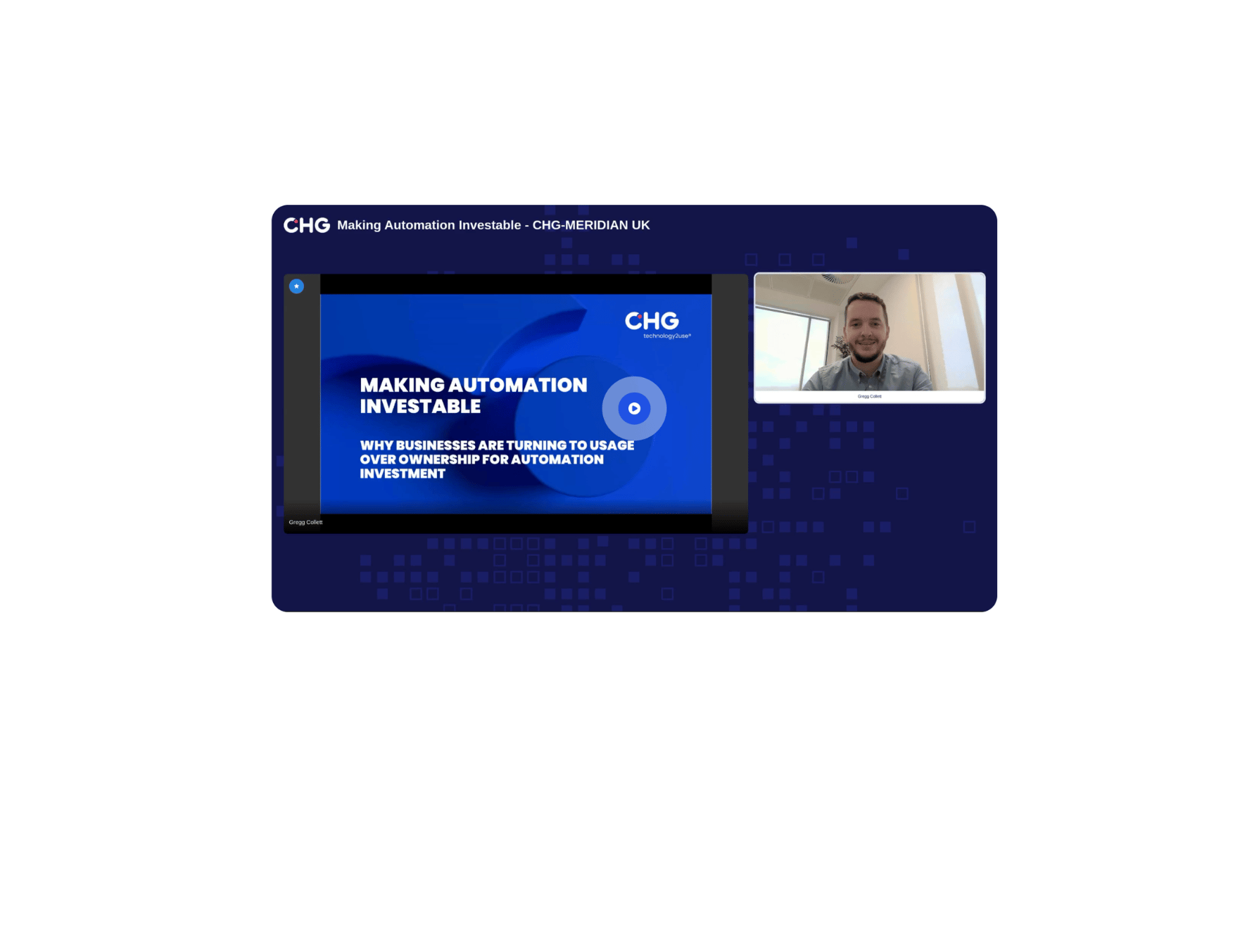
Last month, CHG-MERIDIAN UK hosted its first automation-focused external webinar, Making Automation Investable.
The first thing to say is that, as the sole speaker, it doesn't matter how much preparation you do, nothing really prepares you for how strange it feels speaking into the void for 45 minutes. It's a bizarre experience, but considering we only had one very minor technical hitch, I'd say it went well!
A supplier partner we've worked with in the past reached out to me afterwards (which means somebody was listening… good!) and said they'd been really interested in my comments about ROI.
Return on Investment (ROI) is a significant part of any automation proposal from a supplier, and what my contact told me is that the CHG-MERIDIAN point of view was one he hadn't really considered before.
So we got at least one person to consider a new idea!
During the webinar, whilst addressing some of the common misconceptions about automation investment, I pointed out the tendency to focus heavily on ROI as the ultimate deciding factor in any automation investment decision. My point was that there are significant other factors that play into project approval beyond ROI.
To be clear, that's not me saying ROI isn't important. In most automation projects, it will continue to be one of the most important metrics used when evaluating an investment. Suppliers, investing businesses and internal stakeholders all want a clear understanding of the return a project is expected to generate.
Quite right too!
If you're investing hundreds of thousands, or even millions, into new technology, understanding the financial return is essential.
So my slightly provocative question is… Is ROI the only thing that matters?
Automation isn't a short-term investment
Whether in warehouses, manufacturing facilities, distribution centres or beyond, automation is typically part of a much broader operational vision.
Businesses aren't just looking at what the next two or three years might bring. They're thinking about how they scale, compete and serve customers over the next decade and beyond.
That's why effective project approval discussions have to consider factors beyond ROI alone.
ROI provides an important measure of the expected financial return, while the payback period helps businesses understand how long it may take to recover their initial investment. Both are valuable, but businesses are ultimately making decisions that reach far beyond that initial payback period.
Across various business types, we're seeing more and more questions about enabling future growth, scalability and accessing the latest technology in the future.
Questions around cash flow, flexibility, technology refresh and futureproofing don't replace ROI, but they do sit alongside it.
For example, an automation project might offer a compelling financial return, but businesses still need to consider how it will affect cash flow, whether the technology can support future growth and how easily it can adapt to changing operational needs.
The reality is that discussions around approving an automation project aren't the only ones happening at any one time. The project might have a compelling ROI, but it's also competing against other investment opportunities.
Internal stakeholders are weighing up risk, assessing future requirements, considering how the business might evolve over time and trying to determine whether an investment gives them enough flexibility to adapt if things change.
That's a lot of considerations!
From my experience, the most successful automation projects tend to be the ones that look beyond a single success metric.
The ROI still has to stack up, of course, but the wider conversation often becomes:
"How does this investment support where we want the business to be in five, ten or fifteen years' time?"
Building a stronger business case for Automation
One of our main messages during the webinar was that automation adoption isn't usually being held back by the technology itself. We're talking about proven technologies with clear operational benefits at this point.
The challenge is often building an investment proposition that works for the organisation approving it.
Which is where I think there's a broader conversation to be had than ROI alone.
Not because ROI is becoming less important, but because automation projects are becoming more strategic, more complex and more closely linked to long-term business objectives than ever before.
A strong business case needs to demonstrate the expected financial return, but also explain how the investment supports operational priorities, future growth and the flexibility to respond to changing requirements.
From a personal point of view, I'll take hearing that somebody left the webinar with a slightly different perspective on the topic as a win.
What's so interesting about automation projects is that almost everyone is in agreement on the benefits. The challenge is deciding how to evaluate them.
ROI is always going to be a part of that conversation, but perhaps not the entire conversation.
Key takeaways
FAQs
Is ROI the most important factor when investing in automation?
Return on Investment (ROI) is an important measure when evaluating automation projects, but it should not be considered in isolation. Businesses should also assess operational benefits, cash flow, scalability, flexibility and how the investment supports their long-term objectives.
What factors should businesses consider before investing in automation?
Alongside ROI, businesses should consider productivity improvements, operational capacity, customer service, business resilience and future growth. Financial considerations such as cash flow and investment flexibility also play an important role in building a strong business case.
How can businesses build a stronger business case for automation?
A strong automation business case should combine financial analysis with clear operational and strategic objectives. Beyond demonstrating ROI, it should explain how the investment will improve business performance, support future growth and fit within the organisation's wider investment priorities.